The Load Calculation That Separates A Real Quote From A Guess
Three quotes sit on the kitchen table, and every one lists a different system size. One contractor wrote three tons, the next put down three and a half, the third insisted the house needs a full five. Same rooms, same summer, same 1,800 square foot ranch. Not one of them showed a single line of math to defend the number they picked. The right size is not a matter of opinion, it is the output of a calculation you can check yourself. That calculation is the real test of any HVAC Company Ringgold GA homeowners plan to hire, because it turns a confident guess into a number that either holds up or it does not.
Three Quotes Three Sizes One Wrong Answer
Ask why the three numbers disagree and the answer is almost always square footage. A lot of estimators still size a system with a rule of thumb, one ton for every 500 to 600 square feet, then round up to be safe. That shortcut is how the same ranch collects a three ton quote from one company and a five ton quote from another down the road. The case we see most often is the oversized unit, because rounding up feels cautious and nobody ever gets a callback for a house that cooled too fast.
Cautious is exactly the wrong word for it.
Undersizing is the opposite failure and just as real. A three ton unit in a house that genuinely needs three and a half will run almost nonstop on the worst afternoons. It wears its parts out early and still loses ground when the temperature climbs past 95. Between the five ton guess and the three ton guess sits one correct number, and no amount of sales confidence changes what it is.
The Load Calculation Walked Through Step By Step
The honest way to size equipment is a Manual J load calculation, which adds up how much heat the house actually gains on a hot design day. There is something satisfying about watching those numbers close, the same tidy feeling as a geometry proof landing exactly on the line you set out to reach. That is a tangent, so back to the ranch. Here is the same 1,800 square feet run as a rough calculation instead of a guess.
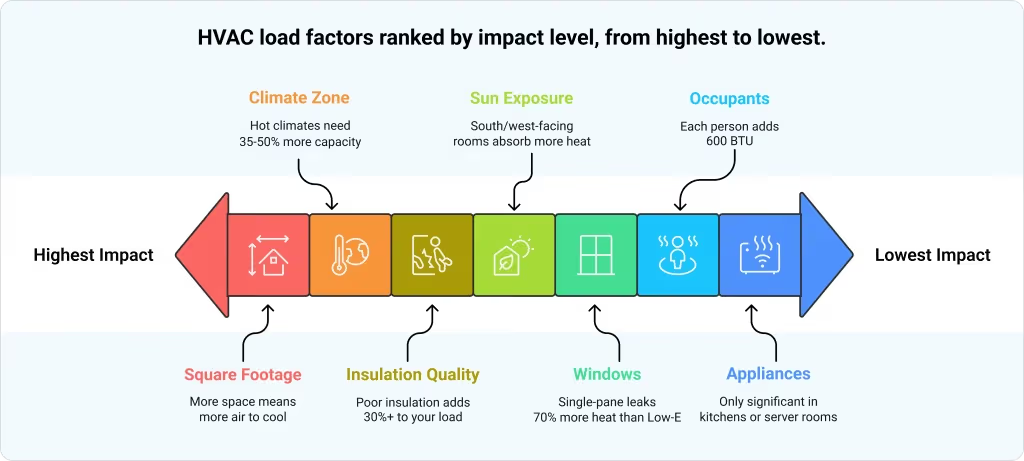
Start with the 1,800 square feet and figure roughly 20 BTU of cooling per square foot for a reasonably tight North Georgia ranch, which comes to 36,000 BTU. Add the six west-facing windows at about 800 BTU each, another 4,800. Add three people at roughly 400 BTU a head, 1,200 more. That totals 42,000 BTU, and because one ton of cooling equals 12,000 BTU, you divide and land on 3.5 tons. A real Manual J goes further, accounting for insulation, duct leakage, and which way the house faces the sun. Even this stripped down version shows the five ton quote was oversized by nearly half.
An oversized system behaves like a fire hose aimed at a coffee cup. It blasts the room cold in a few minutes, satisfies the thermostat, and shuts off. It never runs long enough to pull real humidity out of the air, so the house feels clammy at 74 degrees. Sizing is only half the job anyway, because airflow has to match the equipment. Field monitoring published in ASHRAE’s HVAC&R Research found that swapping in high-efficiency filters measurably choked airflow, dropping it 7 and 11 percent on two test systems. That is enough to hobble a unit that was sized correctly on paper.
You do not have to run the calculation yourself, but you should expect the contractor to. A good one will ask about your insulation, your window count, which way the house faces, and how much duct runs through the hot attic, because every one of those changes the load. When a bidder skips all of that and quotes a size off the square footage alone, that is the signal that no calculation happened.
Right Sizing Is The Whole Ballgame
Right sizing matters more now than it did a few years ago, and the reason is what people are actually buying. More homeowners are installing heat pumps, which have to be sized for both heating and cooling, so a sizing error cuts in two directions instead of one. Even as the broader cooling market softened this spring, heat pump shipments kept climbing, reaching 380,888 units in April 2026, up 1.8 percent year over year. A heat pump sized off a rule of thumb short cycles all July and then runs short on capacity during the first hard freeze.
So when you sit down with competing quotes, ask each bidder to show the load calculation, not just the final tonnage. The load calc does not care how confident the salesman sounded, and neither should you. The HVAC Company Ringgold GA homeowners should trust is simply the one that hands over the math without being asked. Run the numbers on your own house, compare them to what each contractor wrote down, and the right answer stops being a matter of who sounded surest.