The Six Months That Caught A Senior Dog’s Illness Early
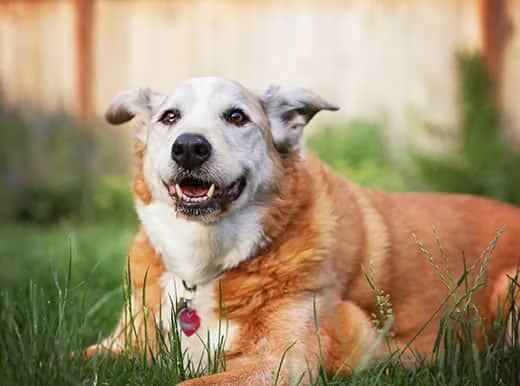
How do you tell a senior dog who is genuinely fine from one who is quietly getting sick? Owners here ask the veterinarians Oskaloosa IA families rely on that exact question, usually about a Labrador who still eats and still greets the door. The honest answer is that you often cannot tell by looking. Two exams a year on a dog past eight catch problems while they are still small, and one exam a year leaves early detection to luck.
A Healthy Looking Senior Dog Can Hide Trouble
Dogs conceal pain by instinct, and Labradors are unusually good at it. What usually turns up is an owner certain nothing changed at home, sitting beside a chart showing four pounds lost since spring. Add more water in the bowl in July and a slower climb up the porch steps. Those are three quiet findings nobody in the house could reasonably have caught.
Waiting is also the expensive route. Veterinary care keeps getting pricier, and the federal price index for veterinary services reached about 189 in December 2025, roughly 10.7% above the year before. That figure comes from the Bureau of Labor Statistics, and it means a problem found late gets treated at next year’s prices.
Skipping Annual Exams Delays Early Detection
A once-a-year schedule sounds thorough until you do the arithmetic on an aging dog. A ten-year-old Lab ages roughly four or five human years between those visits. Kidney values drift and a mass in the mouth grows, with twelve uninterrupted months to do it in.
The bill arrives differently too. Owners who skip the routine visit tend to meet the system in an emergency room instead. A survey of pet owners reported by Forbes put average emergency treatment at about $1,035, and 30% of owners said cost had made them delay emergency care. The veterinarians Oskaloosa IA owners already see for vaccinations can run senior screening on a Tuesday morning, with nothing decided in a hallway.
What Twice A Year Exams Actually Track
The value is not really in any one visit. It sits in the comparison between them. Weight, body condition, dental grade, joint range, heart sounds, and baseline bloodwork mean far more as two readings six months apart. The trend between two exams tells you what a single normal result never can. The scale does not lie, even when the dog looks identical from across the kitchen.
The clinic builds a running health profile out of those numbers, which is the whole point of the exam. Keep your own copy anyway. A free Google Sheets file holding the date, the weight, appetite notes, and anything odd you saw takes four minutes to update after each visit.
How often does this actually catch something early, in plain percentages? I cannot tell you. Nobody I trust publishes a clean figure comparing findings at senior wellness exams against findings at crisis visits. Take the mechanism rather than a statistic, because a six-month gap gives a slow change much less room to hide.
Week One To Month Six A Realistic Timeline
Here is how the schedule feels from the owner’s side, with an eight-year-old Lab as the example. In the first week you book the exam and start writing weights down. The visit runs a physical, parasite testing, whatever vaccinations are due, and a senior blood panel. You leave holding numbers rather than reassurance.
By month three nothing feels different, which is normal and a little boring. You weigh the dog at home once a month and note anything strange. If something shifts early, a two-pound loss or a new limp on the left hind, you call instead of waiting for the calendar.
At month six the second exam compares every marker against the first. A kidney value creeping upward, or a lump that was not there in March, becomes a plan while the dog still feels fine. Month 12 is another comparison and not a fresh start, and by then the chart carries three data points instead of one.
Nothing dramatic happened in those six months. That was the point.
Early Findings Change The Whole Outcome
Early findings are cheaper, and they are also more treatable, which is the part owners feel a year later. Say a senior panel and exam run a couple hundred dollars twice a year at a rural clinic. That figure is illustrative, though it sits well under the emergency number above. A dog seen every six months tends to get a diet change and a recheck, while the one seen annually often arrives with the diagnosis already made. If your Lab is eight and still bounding out to the truck, book the second visit while there is nothing to report.