Measure the Beds Before You Order the Mulch
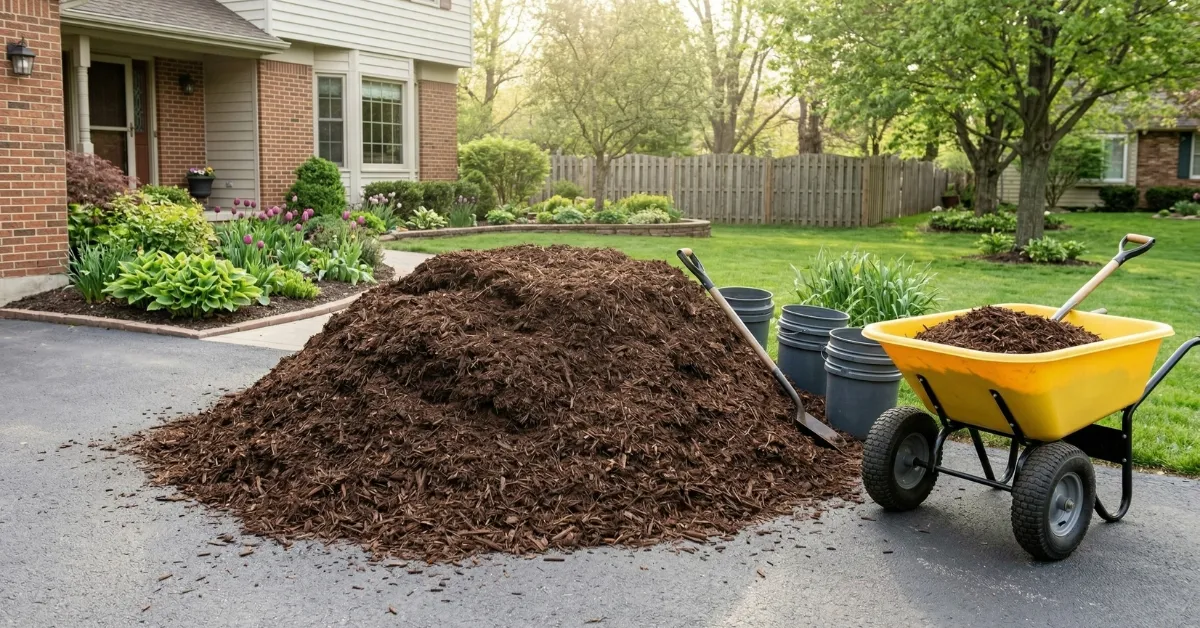
Last April a homeowner off Route 105 walked me around four beds he had mulched himself three weekends earlier. He had bought what looked like plenty, spread it thin across roughly 400 square feet of curved border, and by the last week of June the creeping charlie was standing up through the whole thing as though nothing had ever been laid down at all. Anyone pricing mulch monticello il beds should ask one question before signing anything, which is how the volume number on that estimate was calculated. Depth decides the rest. Get the cubic yards right and mulch smothers weeds and holds water through the season, and guess at them instead and you have paid for a decorative dusting that quits in July.
Thin Beds Always Trace Back To Guessing
Job after job, the same thing turns up. The customer bought by the bag instead of by the bed, and eight two cubic foot bags spread across a 400 square foot border works out to roughly half an inch of cover once it settles. Light is what does the suppressing here, not the wood itself. A January 2026 meta-analysis hosted by the NIH’s PubMed Central library pooled 9,413 paired field trials and credited mulch film with 42% weed suppression, attributing the effect to opaque coverage of the soil surface. Shredded hardwood gets there by a slower route and only reaches that kind of opacity at real thickness, which an inch of scattered cover never delivers no matter how evenly it was raked out.
Ten years ago nearly every residential bed I looked at had been mulched out of the trunk of a car, three cubic feet at a time, and the shortfall was easy to miss because nobody was tracking a running total. Bulk yards changed that. Prices are posted per cubic yard now, delivery comes by the scoop, and a bad estimate announces itself either as a leftover pile baking in the driveway through August or as a bed that ran dry at the last curve. Cheaper per unit, far less driving, but it does demand that somebody run the numbers before the truck is loaded. The bag era let you fake it; the bulk era does not.
That is the whole mistake in one line. Everything after this is arithmetic.
Doing The Cubic Yard Math On Site
Break each irregular bed into rectangles and rough circles, measure the pieces, and add the areas together. Curves are not worth agonizing over, since a kidney shaped bed measured as a rectangle overshoots by maybe eight percent and you would rather have the extra than come up short at the last two feet. Multiply the square footage by your target depth expressed in feet, then divide by 27, because a cubic yard holds 27 cubic feet. Three inches is 0.25 feet. Four inches is 0.333. The whole thing takes six minutes with a tape and the calculator already in your pocket.
Say the front border runs 38 feet by 6 and the island bed around the maple measures close to 12 by 14. That is 228 square feet plus 168, so 396 total. At a 3 inch depth, 396 times 0.25 gives 99 cubic feet, and 99 divided by 27 comes to 3.67 cubic yards. Call it 4 yards on the order. Honestly, closer to 4.5 once you account for settling and crowned edges, which is where I usually end up after walking a property with the customer.
The trade has grown big enough that this arithmetic is standard estimating work rather than a courtesy, and Mordor Intelligence sizes American landscaping and gardening services at about $125.77 billion in 2026 on a path toward $169.36 billion by 2031. A crew quoting mulch monticello il properties should hand you square footage, depth, and yardage without a trip back to the truck. If the estimate jumps straight to a price, ask. In practice a contractor who cannot show you the volume is guessing the same way the homeowner did, only with a bigger wheelbarrow.
Measured Beds Hold Mulch Through August
During the first week of May a bed at three inches and a bed at an inch and a half look nearly identical from the street. July tells the truth. The thin one has compacted, rain has washed it off the crown of the bed, and sunlight is reaching bare soil again right as the heat sets in. Moisture works on the same principle, because a properly measured layer lets the top inch dry out while the material underneath still holds water down where the roots are, which is what carries shrubs and hydrangeas through a two week dry stretch in Champaign County.
Depth has a ceiling too. Piling six inches against a trunk or over shallow feeder roots traps too much water and starves them of air, and that shows up the next spring as dieback nobody connects back to the mulch. What usually turns up on a re-mulch is that last year’s layer never fully broke down, so the right move is raking and fluffing what is already there and topping with an inch rather than burying it under another three.
Measure the beds once, write the square footage on a card, and keep the card, because beds rarely change shape from one spring to the next. Depth is the part you adjust, three inches on established borders and nearer two around shallow rooted perennials so the crowns are not buried. When the math says nine yards and the driveway will hold four, hiring the crew with the dump trailer stops looking like a splurge and starts looking like the cheaper end of the deal. The tape measure is not going to argue with you about any of it.